
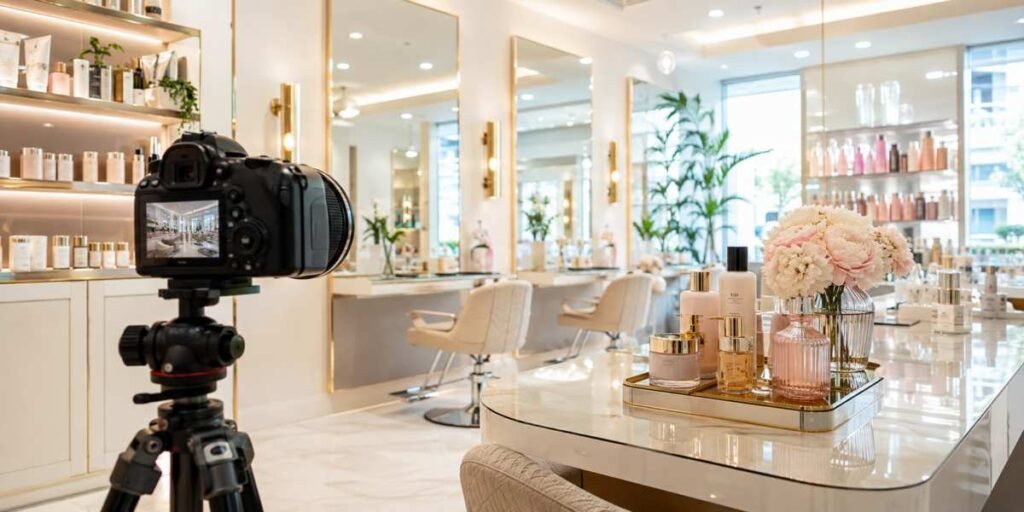
Reflections are part of what makes many beauty shops visually appealing. They contribute brightness, depth and the immaculate finish associated with cosmetics and personal care. The aim, therefore, is not to eliminate every reflection. It is to control which reflections become part of the photograph and which ones quietly disappear.
Start by Studying the Mirrors
Before setting up lights or choosing lenses, walk around the shop and look at it from different positions. Mirrors behave very differently with surprisingly small changes in camera location. Moving half a metre sideways can turn a reflection of a doorway, tripod or photographer into a clean view of an attractive display.Large wall mirrors deserve particular attention because they effectively create a second composition inside the first. Check not only what appears directly in front of the camera, but what is visible behind it. A beautifully arranged cosmetics counter can lose some of its glamour when the mirror reveals a stepladder, cardboard delivery box and someone’s abandoned coffee cup.
Camera height also matters. Raising or lowering the camera slightly changes what a mirror sees. Experiment before rearranging the entire shop. Sometimes a modest adjustment is enough to hide unwanted equipment behind a counter or place the photographer outside the reflected angle.
Treat Glossy Surfaces as Small Mirrors
Mirrors are obvious troublemakers, but polished counters, metallic shelving and shiny product packaging can be considerably sneakier. A chrome fitting may occupy only a tiny part of the frame yet produce a bright highlight strong enough to attract immediate attention.Examine reflective products from the camera position rather than assuming they look fine because they look fine while standing beside them. Bottles with metallic caps, perfume boxes with foil lettering and glossy cosmetic containers can all produce distracting patches of light.
Small adjustments are often preferable to major interventions. Rotating a bottle by a few degrees, shifting a display slightly or changing the camera angle can transform an ugly white glare into a controlled highlight that helps communicate the product’s polished finish.
Control the Light Before It Controls You
Bright direct lighting can turn reflective interiors into a collection of miniature suns. Softer, broader light sources are generally easier to manage because their reflections appear smoother and less aggressive.Where possible, make use of diffused daylight and existing shop lighting, then introduce additional illumination carefully. Watch reflective surfaces as each light is added. If a new light improves the shelves but creates a spectacular glowing rectangle in the mirror, it has solved one problem by submitting an application for another.
The most useful approach is deliberate and incremental. Build the lighting gradually, checking mirrors, glass, chrome and packaging from the final camera position each time. That makes unwanted reflections easier to identify before they multiply across the frame.
Keep the Camera Out of the Story
Avoiding your own reflection can become an unexpectedly athletic part of photographing a beauty shop. Shooting directly towards a mirror naturally increases the chance that the camera, tripod and photographer will make an unwanted appearance. Moving slightly off-centre is often enough to solve the problem while maintaining a natural-looking composition.Longer focal lengths can also help. By stepping farther back and narrowing the field of view, it may be possible to photograph a display without standing directly within the mirror’s reflected area. Doorways, shelving units and structural columns can sometimes provide convenient hiding places. There is no particular dignity in crouching behind a promotional display for moisturiser, but the photograph will never know.
Be especially careful when several mirrors face one another. A camera that is invisible in the nearest mirror may appear unexpectedly three reflections deep in another one. Examine the entire image rather than concentrating solely on the most obvious reflective surface.
Use Framing to Simplify Busy Areas
Beauty retail spaces often contain large quantities of small products, signs, illuminated displays and decorative details. Add reflections to that mixture and a photograph can quickly become difficult to read. Careful framing gives the viewer somewhere obvious to look.Not every photograph needs to explain the whole shop. Alongside wider views, capture medium compositions showing individual counters, consultation areas or product displays. Detail photographs can concentrate on packaging, textures and carefully arranged merchandise without including every mirror in the building.
Look for strong lines created by shelving, counters and lighting. These can guide attention through the image and prevent reflective elements from competing with the main subject. Leaving a little visual breathing room can also make luxurious interiors appear calmer and more considered.
Don’t Remove Every Glimmer
There is a danger in becoming so determined to defeat reflections that the shop loses its character. Gloss, glass and polished metal are frequently deliberate parts of beauty retail design. Completely flattening those surfaces can make an expensive interior look strangely dull.Controlled highlights help describe materials. A soft reflection across a glass counter communicates its finish, while a restrained shine on metallic packaging gives products shape and dimension. Even mirrors can make a relatively compact shop feel more layered when their reflected views are clean and intentional.
The distinction is between reflections that contribute information and those that create distraction. A reflection revealing another attractive section of the shop can add depth. One revealing the photographer checking the back of the camera generally contributes rather less.
A Beautiful Reflection on the Result
Successful beauty shop photography does not require declaring war on every shiny object. It requires noticing how reflective surfaces interact with the camera and then making small, deliberate adjustments to position, lighting and framing.Take time to inspect images at a useful size during the shoot. Tiny unwanted reflections can be surprisingly easy to miss on a quick glance, particularly around chrome fittings and glossy packaging. Correcting them physically is usually preferable to discovering them later when dozens of photographs require retouching.
A polished beauty shop should still look polished in photographs. Mirrors should create space rather than confusion, highlights should describe surfaces rather than overwhelm them, and glossy products should retain their appealing finish. Once those elements are controlled, all that troublesome glass and chrome stops behaving like an obstacle and starts doing exactly what the designer intended: making everything look rather splendid.
Article kindly provided by gdholland.co.uk – retail photographer