
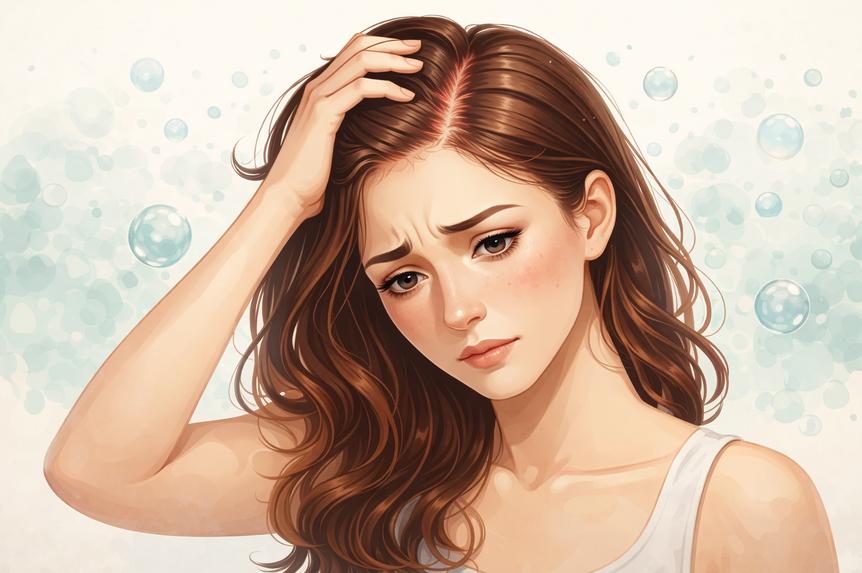
Hair sits on your head like a guest, but your scalp is the landlord. If the landlord is unhappy—dry, irritated, congested—your hair will absolutely reflect that chaos. You can keep switching products, but if the foundation is off, everything built on top of it will wobble.
Scalp Skin Is Still Skin
It’s easy to treat the scalp as a separate category, something closer to “hair territory” than actual skin. But biologically, it’s no different from the skin on your face. It has oil glands, a moisture barrier, and a microbiome. It can get clogged, inflamed, dehydrated, or sensitized—just like your cheeks or forehead.Ignoring that similarity leads to some interesting habits. People who would never scrub their face with harsh cleansers will happily use stripping shampoos several times a week. Others who carefully layer serums on their face forget their scalp exists entirely unless it starts itching like it’s filing a complaint.
The result is predictable. An imbalanced scalp produces excess oil, flakiness, or irritation, and hair growing from that environment often ends up limp, brittle, or difficult to manage.
Oil Imbalance Isn’t Just a Hair Issue
Greasy roots are usually blamed on “oily hair,” but hair itself doesn’t produce oil—your scalp does. When oil production is out of sync, your strands are simply along for the ride.An overactive scalp can flood hair with oil, making it look flat and heavy within hours. On the flip side, a dry or compromised scalp might overcompensate, triggering more oil production in a slightly desperate attempt to fix itself. It’s a cycle that feels personal, but is actually just biology doing its thing a little too enthusiastically.
Managing this isn’t about punishing your hair with stronger products. It’s about calming the scalp so it doesn’t feel the need to swing between extremes.
Buildup Behaves Like Clogged Pores
Think about how pores behave when they’re clogged—dullness, congestion, occasional breakouts. Now apply that idea to your scalp. Product residue, sweat, oil, and environmental debris can accumulate over time, especially if you rely heavily on styling products or dry shampoo.The scalp doesn’t politely ignore this buildup. It reacts. That reaction might show up as itchiness, flakes, or hair that suddenly looks lifeless despite your best efforts.
Regular, gentle exfoliation can help, but this doesn’t mean attacking your head with something that feels like sandpaper. A well-balanced approach keeps the surface clear without triggering irritation, which is a very easy line to cross.
Irritation Has Consequences
A sensitive scalp rarely stays quiet. Redness, itching, and discomfort are signals that something is off, and ignoring them tends to escalate the situation. Over time, irritation can affect how hair grows and how it feels once it’s there.Sometimes the cause is obvious—harsh ingredients, overwashing, or environmental stress. Other times, it’s the slow accumulation of small habits that individually seem harmless but collectively push the scalp into a reactive state.
There’s a tendency to treat these symptoms as inconveniences rather than indicators. But a consistently irritated scalp isn’t just annoying; it’s a sign that the underlying environment isn’t supporting healthy hair at all.
Treat Your Scalp Like You Treat Your Face
If your face gets cleansed, hydrated, and occasionally exfoliated, your scalp deserves the same basic respect. It doesn’t need a ten-step routine or a dedicated shelf in your bathroom, but it does benefit from some intention.Start with how you cleanse. Washing your hair isn’t just about removing visible oil—it’s about keeping the scalp environment balanced. Over-cleansing can strip away protective oils, while under-cleansing allows buildup to settle in like it pays rent. Neither outcome is particularly helpful.
Hydration is another piece that’s often ignored. A dry scalp can feel tight, itchy, and uncomfortable, yet many routines focus entirely on ends and lengths. Lightweight scalp treatments or hydrating formulations can make a noticeable difference without turning your roots into an oil slick.
Then there’s exfoliation, which should be approached with restraint rather than enthusiasm. The goal is to clear away buildup, not to provoke your scalp into a dramatic response.
- Use gentle, non-stripping cleansers that maintain balance
- Incorporate occasional scalp exfoliation to prevent buildup
- Add lightweight hydration if your scalp feels tight or irritated
- Avoid layering too many styling products directly at the roots
Stop Blaming Your Hair for Everything
Hair tends to get all the attention, which is slightly unfair considering it has no biological agency. It doesn’t decide to be greasy, dry, or uncooperative. It simply reflects the conditions it’s growing in.When something feels off—lack of volume, dullness, persistent oiliness—it’s tempting to switch shampoos or experiment with yet another styling trick. Sometimes that works. Often, it just adds another variable without addressing the root of the issue, quite literally.
Looking at the scalp instead shifts the entire approach. It turns hair care from a reactive cycle into something more stable and predictable. That doesn’t mean perfection, but it does mean fewer surprises that show up five minutes before you need to leave the house.
Good Hair Starts Where You Rarely Look
Healthy-looking hair isn’t just about shine or smoothness—it’s about consistency. And consistency usually comes from a scalp that isn’t constantly swinging between extremes.Treating the scalp as skin rather than an afterthought creates that stability. It reduces the likelihood of oil spikes, dryness, and irritation, which in turn makes hair easier to manage without constant intervention.
There’s something slightly ironic about it. The part of your routine that often gets the least attention ends up having the most influence. Once you start focusing there, the rest of your hair care routine tends to feel a lot less like a guessing game and a lot more like it actually makes sense.
Root of the Matter
Hair problems often feel like surface-level annoyances, but they usually begin much deeper. Paying attention to the scalp isn’t about adding complexity—it’s about removing confusion. When the skin underneath is balanced, your hair has a far better chance of behaving itself, which is a win for everyone involved, including your morning routine.Article kindly provided by gloavia.com